Workshop at Linhof & Studio

Paula and I will be running another LF workshop in Leigh on Sea in spring 2008. Details will be posted on the Linhof website in due course or if you just can't wait contact Paula on +44(0)1702 716116 for further details and to reserve a place.

Saturday, 24 November 2007

Now for some shameless self-promotion...

I've been persuaded to produce a hardback version of my next book, Landscape Beyond, in a limited edition of 500. This will only be available by mail order from me or via Eddie's Envisage Books and final pricing has still to be worked out.

I will also be having my first London exhibition in conjunction with my good friend Anna Booth. Our images will be on view at the OXO Gallery on the South Bank from April 22 to 27 2008. More details on this as we get nearer the time...
No post for ages then they all come at once...

For me photography is a voyage of exploration. I believe that we all start with a sense of enquiry, a sense of wonder at our chosen subject. The voyage that we embark on is to discover the limits of what we know about technique, to explore the subjects that we photograph and, perhaps, to open up the unknown territory of our spirit.

I was recently asked by Eddie Ephraums to look at a book that reflected the journey to date of a photographer who I have witnessed at first hand grow from unskilled novice to someone who now taking his first unsupported steps on his personal voyage of exploration. The book is called “Writing with Light” and contains the work of Sami Nabeel. It prompted me to think how a photographer might make the journey from “taker” to “maker” of photographs, from technically competent illustrator to expressive photographer as Sami has.

If I had been writing about this journey at almost any other time in the last couple of thousand years there would have been a well trodden route that the artist would have followed, from indentured apprentice to craftsman and, for the gifted few, on to acknowledged master. But no such clear-cut path exists today. The vast majority of people, like Sami and many of my readers, who would call themselves photographers have “proper” day jobs. Photography is something that they are driven to do in the nooks and crannies of their lives, in the gaps between work and family commitments. It would be impossible for most to give up a regular income in order to pursue photography full time. You may have noticed that I make no distinction between amateur and professional photographer. Like any other artistic endeavour, the title “photographer” is one earned by achievement rather than one achieved by earnings.

With little chance of an apprenticeship the two ways that one might learn one’s craft are by studying the example of “masters” in books or magazines or by interacting with fellow enthusiasts. The problem with either of these approaches is that one needs to receive genuine constructive feedback in order to grow. Studying the printed work of masters only gets us so far. Most books, with notable exceptions, are portfolios or technical “how to” treatises rather works that aim to provide answers to why an image was made. Without a dialogue to explain the difficulties they encountered and their approach to finding a solution all we can really do is admire the result.

In the case of the popular camera press things are even worse. The percentage of good work is quite low and genuine critical frameworks are almost entirely absent. The approach more often undertaken by the staffers vacillates between meaningless epithets and snide criticism. I doubt that many staff writers actually give much thought to what might constitute a meaningful critique. Most are journeymen who concentrate on simple narrow matters of technique, that can be learned by rote, and opt for cheap attacks to hide the depth of their ignorance. One UK photo magazine in particular had a long running series where two of the staffers adopted the good cop/bad cop position of alternately praising to the heavens and then tearing the photograph apart. What this was supposed to teach anybody who contributed an image to this futile exercise is beyond me.

Seeking opinions on our work from our peers can be useful. The developing photographer might turn to camera clubs or the Internet and in theory these should provide them with much needed feedback. The main problem here is one of finding the golden ingots of wisdom hidden below the dross. Feedback from Internet forums is often patchy, with either too many opinions on offer or none at all. Sadly, once again, the opinions tend to lack any rigour. Being told that your image is “great” or “crap” or (the worst of all) “nice” doesn’t help you progress. It seems to me that for visual artists photographers in general (and sweeping generalizations are always good!) have an extremely poor insight into why some images work and others don’t. Most avoid thinking about such questions by literally hiding behind the camera. They focus on the technology and don’t ask why they’re making images or what those images might be telling us. Others avoid asking such questions by resorting to the, “It’s all a matter of taste” argument. Postmodern art has been built entirely on this shaky foundation. Despite everything that such artists say, most of which is deliberately obfuscate, art isn’t art just because the artist says it is. It’s no good just saying “It’s Art, innit.” Opinions in art, just as much as in any other field, need to be backed by reasoned arguments. Modernism firmly defined the artist’s role as searching for self-expression but this is meaningless without insight into one’s opinions and the maturity to articulate them. You have to have something to express. Some years ago, Joe Cornish and I were discussing our landscape photography peers (men do gossip) and noted that none were less than forty years of age. At the time we had no real explanation for this. But I now think that it’s a simple case of needing to have had considerable experience of the landscape before one can make significant images. One can master the technology very quickly but a meaningful connection to the landscape can only come with experience. And experience can only come with time spent in the field.

The general lack of a prescribed direction means that many photographers struggle alone for years before they find their way beyond illustration. There may not be the recognised apprenticeships of old but photographers can still seek mentors. This is the role that I and some other photographers seek to fulfil for students by leading workshops. When I began teaching photographic workshops I had no idea how involved I would become in the photographic journeys of my students. Seeing how students grow in confidence and find their own voices has been both a revelation and a deeply rewarding experience for me. For most students the journey that they undertake is quite modest; they wish to master the equipment so that they might make a faithful “copy” of a landscape that inspires them. For others it is a much longer and harder journey: one of constantly trying to fill in the blank areas on the map of their knowledge.

However much the journey varies two things are absolutely clear to me; the student needs to make a serious commitment and they have to believe in themselves. It takes considerable time and energy for the student to find the route to move beyond simple illustration. Even with the outside assistance of a mentor they still need to act as pathfinder through their own jungle of possibilities. All I or any other mentor can do is try to steer them in the right general direction – a little like saying, “Just head west.” It might help in the end but there will certainly be sticky moments along the way. The terrain that they traverse will to some extent dictate their path. There may be ravines that they cannot cross, deep problems to which they have no answer. The mentor can suggest ways to bridge the gap or alternate paths but once again the exact route is for the student to find. They may find pleasant meadows where they wish to linger, but they should be cautious of the easy life. This may lead to complacency and a lack of progress. As I’ve opined before, the life of a photographer is much more akin to that of a hunter-gatherer rather than a farmer. We need to constantly move on and find fresh game.

When I said that the photographer needed confidence to successfully complete their passage from “taker” to “maker” I didn’t mean that they needed to be cocky. They need quiet self-belief that they can manage the journey; self-criticism is essential but they need to be careful that it doesn’t deteriorate into self-doubt. It is easy to remain in the shadow of those who have preceded us – indeed a poor mentor will prevent you from leaving their shadow. The photographer needs confidence that what they have to say is worthwhile if they are to move beyond making banal and vacuous pastiches of our photographic heroes images. A major part of what the mentor does is to provide them with this confidence.

So, what of Sami’s personal journey? When I first met Sami in 2003, he had a 5x4 camera but was struggling with its basic operation. He very quickly mastered the camera but this was only the first and in some ways least significant step. He then began to explore what he wanted to express in his photography. There were many dead ends and false starts, images that failed to meet his critical expectations, but bit-by-bit he began to develop a vision of his own. Four years is an astonishingly short period in the artistic journey of a landscape photographer but he has travelled a very long way since those first hesitant steps. I hope that he still feels, as I do about my own work, that there is still a long way left to travel. The day that we feel we have arrived is the day that the journey ends, the day to turn our back on photography. What keeps us exploring is the quest for unknown territory; looking for ways of seeing that are new to us, images that surprise and delight us. My own journey has been filled with unexpected twists and turns and I pray that it continues to surprise me. If I have taught Sami anything I hope it is that it is better to travel than to arrive.
Long time no post...

Where did two and a half months (since my last 'serious' post) go to?!? Perhaps I'm just having a senior moment... but, no. I do recall. Since I last visited you and the other reader I have been engaged in various projects for Light & Land as well as finishing off work on my next book Landscape Beyond.

The text for this was finished back in August but the final image selection and layouts weren't completed until late October. I'm relieved to say that it has now gone off to the printers – though not as relieved as the tireless Eddie Ephraums who has done a sterling job despite my interference/involvement in all stages of the process.

So, how do I feel about my new baby? Well in some respects I think that I'm still too close to it to judge properly. I'm reasonably pleased with the images but don't feel that I can really judge the text yet. I think that this book is more personal than Landscape Within and I felt more outside my comfort zone than when I wrote LW. I owe a big thank you to Eddie for the inspiration for the book. When he and I first sat down to talk about my "difficult second album" he asked me to name the three attributes that I felt essential in the creation of a great landscape photograph. I surprised myself by instantly responding, "Simplicity, mystery and beauty." And a book concept was born. Of course the tricky part was writing the text...

The images used were largely already made. I like to approach the making of a book with a set of images from my 'library' rather than shooting to illustrate the text. I find that this suits me for a number of reasons. Firstly, I'm not the most prolific photographer and the idea of making a set of images to order is frankly very scary. Secondly, because the images aren't meant to be literal illustrations of the text but to stand as works on their own there really isn't the need to shoot specifically to fulfill the brief. For me, the words and images work together and separately, they are interleaved but distinct.

The inspiration for each of my images comes from the circumstances of its making rather than from some grand plan. In fact I find it more or less impossible to make anything other than bland illustrations if I have an external structure imposed before I make an image. Some might see this as a weakness: it means that I feel unable to work on image series. I tend to feel that my photographic work to date is in a sense one very large series charting my explorations in photography. There are many examples of artists having periods working on the same or similar subjects (Picasso's Blue Period is perhaps the most famous) and I do this too. I make series inadvertently (and each image is widely separated in time) because I have a 'weakness' for certain subjects such as ferns or windows. I often worry that rather than working through my approach to a topic I might simply be pointlessly repeating myself. Yet, just when this feeling gets really strong I usually find some new approach and reveal something new to myself and hopefully whoever views the images. Perhaps I should go away and think on this some more...

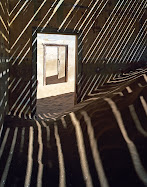
In between work on the book I've made two trips across the pond to visit the Canadian Rockies in September and Montana & Wyoming. Both were reasonably successful photographically (the image above was made at Biscuit Basin in Yellowstone) and I'll write more on them in future posts.

Friday, 28 September 2007

Linhof & Studio September 2007 Large Format Workshop

I promised the participants of this workshop that I would upload a post for them to leave their comments and questions about the workshop and LF – so here it is! Please do ask me about anything arising from the workshop and I will try to answer it as soon as possible. I'm afraid that I will only be able to answer questions from the participants so the rest of you will just have to eavesdrop...

Friday, 31 August 2007

One hour to midnight...

Well, with three days to go it looks like I might actually get my text for the next book in on time so I thought I'd take a minute or two off to share another image from my trip to Norway with you both.

It occurred to me whilst I was in Norway that the lifestyle of landscape photographers has parallels with that of hunter-gatherers. Like hunter-gatherers, landscape photographers tend to lead a "nomadic" lifestyle, reliant upon the ability of a given natural environment to provide sufficient photographic opportunities in order to sustain our photography habit.

The variable availability of light and cloud, owing to local climatic and seasonal conditions, means that we are unlikely to stay in one place for long. Rather than bagging a kudu or digging a witchetty grub out of a eucalyptus tree I’m searching for a composition. Both ways of life sustain the individual but whereas the hunter gatherer is feeding their body I'm trying to feed my mind and spirit. Of course, many would claim that being a hunter gatherer is better for their soul (and waistlines!) than Western capitalist lifestyles.

Mmm, life's full of difficult decisions – a fresh wichetty grub or a new composition... I'll have mine toasted on the camp fire!

I'll be back next month, hopefully with something more insightful.

Sunday, 19 August 2007

Gone fishing...

Sorry for the lack of posts recently but I was away in Norway at the beginning of this month and I am now frantically trying to finish the text of my next book. Aaaarggghh...

So I'm afraid that I don't have any great personal philosophical insights to pass on (did I ever?) but I would like to draw your attention to a fascinating article by a painter called Martin Dace: Towards a new art

It's a wonderful and insightful critique of Postmodernism (well, see KK's post in comments for an alternative view!) and a plea to return to older values for art.

Please do post any comments you have on it and I'll give you my thoughts.

Back to the white hot keyboard (aalctuly olny luke wrsm as I can't tpye that fadt... well not accurately)

Sunday, 15 July 2007

A guilty pleasure?

I'm referring to showing my images in person to someone else – the prospect of which always makes me feel very nervous indeed. Yet, something still makes me go through the trauma of showing my photographs. Perhaps something about the process gives me pleasure? Am I just revelling in showing off, feeding my ego? I don't think so; it's a bittersweet experience for me, a mixture of anxiety and a hint of gratification. Of course it's the gratification that makes me feel guilty...

On the face of it, surely I should have nothing to worry about when sharing my images. I've been making photographs for close on 30 years, my images have been published in over 20 books and a number of magazines and I've achieved some recognition from my peers for the quality of my photography.

But worry I do. When presenting my images to an audience, large or small, I feel diffident; I worry that my images are unworthy, I worry that the audience won't like them – more than that they won't love them as wholeheartedly as I do.

Don't get me wrong, I don't love all my images and I'm not labouring under the misapprehension that those I do love are perfect. I know that they're not. I'm fully aware that even my favourite images have faults in composition or execution. In fact I'm painfully aware of this, its as plain and as haunting to me as a disfiguring ulcer on the face of a dear friend. I'm certainly more aware of the faults in the image than my audience are. Yet, despite their faults, I still love these chosen images. My images are the offspring of my creative spirit and I love them in the same way that I love my children: unconditionally.

I know deep in my heart that I've made a few images that will stand comparison with the best of my peers. I just don't want to shout about it (though I suppose my two readers might legitimately accuse me of at least whispering loudly through "Oceans..."). Why don't I want to be demonstrative? Is it because I'm English? The butterflies in my stomach let me know that I'm not exhibiting false modesty when I shrink from the limelight. If I were supremely confident but trying not to let my audience see that arrogance I wouldn't feel this bad. Paradoxically I feel confident and unsure at the same time; confident that my images are good but also unsure that they are good enough.

The reason for my fluctuating confidence might lie in part in the findings of a study by Dr. David Dunning at Cornell University. He looked at confidence in relation to ability levels. Dunning compared a group of students scores in a series of tests against their expectations. He found that those with the lowest scores consistently overestimated their abilities. More than that, Dunning's team also found that those with the highest scores consistently underestimated their abilities. The researchers put this down to "the fact that, in the absence of information about how others are doing, highly competent subjects assumed that others were performing as well as they were". I'm sure that this is partly true, but I also know from my own experience that the more I learn about photography the more I realise what there is still to learn. The more I know the smaller my precious hoard of knowledge looks and the more insignificant I feel.

Given my discomfort at showing my images in person, should I, perhaps, confine this activity to only showing them to people who's opinion I value? No, I don't think so. However unpleasant it is for me I need to show my work to as wide an audience as I am able and to listen to what they have to say. I've said before that self-criticism is an essential part of the creative process but I feel that peer review is also – and not just garnering the uncritical opinions of those you trust. That way lies a complete lack of perspective and the withering of creativity. I think that we've all seen this effect from afar in the work of certain pop musicians. There comes a critical point in some successful pop careers where the performer has amassed a considerable amount of money and acquired an entourage. If they are unwise they will have surrounded themselves with yes men;

"Do I look good in this outfit?"
"Yes!"
"Isn't my latest single great?"
"Yes!"
"Wouldn't it be great if I drove my Rolls into the swimming pool?"
"Yes!"
"I am the new messiah!"
"Yes you are!"

You get the picture...

It's been unspoken, perhaps even unconscious until now, but it occurs to me that the reason I show my images is not to feed my ego but to get a perspective on my work. It makes me anxious but I want to find out if I'm one of those incompetents in Dunning's study who is overestimating their ability or if there is some merit in what I'm doing. It would be foolhardy to grant all opinions equal weight but also equally foolhardy to dismiss out of hand those that are critical. There therefore needs to be some system of checks and balances. My approach has been to compare three sets of opinions; my own self-critical view, the opinions of a wider audience and finally the views of those members of my peer group whose work I admire. I tend to filter out opinions that are universally positive in favour of ones where I feel the respondent has made an effort at providing a critique.

The anxiety, then, comes from putting myself up for judgement, opening myself up for criticism. Gratification comes from any degree of validation of my work, especially if that approval comes from those members of my peer group who's work I admire.

So, is it a guilty pleasure? No, I don't think so. It's important to seek and find external positive feedback to counter the inevitable negative effect that arises even from constructive self-criticism. As photographers we need perspective and a context for our work beyond that provided by our own egos. But we also need encouragement if we aren't to become irretrievably disheartened. Showing my images is scary but I just have to grit my teeth and do it!