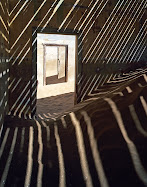
Workshop at Linhof & Studio

Paula and I will be running another LF workshop in Leigh on Sea in spring 2008. Details will be posted on the Linhof website in due course or if you just can't wait contact Paula on +44(0)1702 716116 for further details and to reserve a place.

Monday, 30 April 2007

Dear Doctor...

"My friend has a problem. He seems only to be able to make crap photos at the moment even though he is a good photographer. Does this happen to you ever? I do hope that you can help him!" A reader (name & address withheld)

This is a common problem amongst men and women of a certain age and I certainly do have periods when I don't take any good images. Such dry periods may last for a few days or even weeks. The image at left was made last summer after a week or so of not being able to see a single decent composition. But, quite suddenly, when I had almost given up hope of seeing anything worth photographing I saw this composition. I was walking along a beach without my camera and had to rush back to the vehicle to get my gear (N.B. no rocks were moved during the making of this image!)

More often than not this lack of vision is just a result of not being in the right frame of mind. I find that I need to empty my mind of other distractions – like how I can possibly afford to pay the gas bill or which colour shirt goes best with my eyes (puce) – before I can hope to see anything. I know that for many of us finding the time to make images is hard enough, never mind finding the time to get in the right frame of mind but this step is crucial if we want to make original photographs and not just revisit old ground. It's better to take one's time rather than rush and peak too soon (another common male problem...)

I used to feel very frustrated when I couldn't see, blaming myself for a lack of ability or insight, but I've since realised that I usually just need to clear my mind and relax into picture making. Getting frustrated just makes it worse! OK, I'm not perfect and I do still get frustrated sometimes.

Sometimes this dry period indicates a forthcoming change in my photography. I think that what's happening is a shift in my perception, a reassessment of my work that has gone before or, most excitingly, it might signal my turning onto a completely different artistic heading.

So, I've now begun to see this lack of image making as a positive thing. I know it can be frustrating and depressing but I can assure you that your "friend" hasn't lost the ability to make images. You are probably – sorry I mean he is probably beginning to see things differently and this will eventually work its way through to making new and exciting images.

Saturday, 28 April 2007

Egoist or egotist...

One of my readers recently said to me that she felt that my images and Joe Cornish's images had no trace of our ego in them. I was puzzled by this comment so I asked her to expand upon her thesis.

As I understand it (and please let me know if I'm wrong – you know who you are!) she meant that the photographic message wasn't being distorted by our egos; that he and I weren't being vain or showing off, but simply trying to convey our feelings about the subject in hand to a wider audience. And furthermore, that this selfless approach gave our images clarity and veracity.

I'm not at all sure that what I do is selfless, in fact I'm fairly certain that, from my perspective, it's the ultimate selfish act. What I'm trying to do, first and foremost, when I make a photograph is to express my feelings about a subject. I can hope that others may like my work but ultimately I make all my images for me. And what makes me share them with others is another selfish desire.

After the creative urge, one of the deepest desires of an artist is to be praised by one's audience, to be recognised for one's work by one's peers, to be patted on the back – in short, to have one's ego well and truly massaged! This is of course also the reason that we find external criticism of our work so difficult; when someone attacks our work they are attacking our personalities at the deepest level. An artist's images are an expression of their inner self. So saying that an image is rubbish isn't at all the same as saying that you hate the cut of their clothes or even that you hate the colour of their hair. These physical manifestations (even though the latter might have a fundamental genetic link!) are only about surface, mere appearance. You can always change your tailor or buy some hair dye but saying an image is poor is an attack on our ego, the very basis of our being.

John Szarkowzki, the American photographer and former Museum of Modern Art curator, organised an exhibition entitled "Mirrors and Windows" at MoMA in New York in 1978. His premise for the exhibition was that all photographs are either "mirrors" of the photographer's concerns or "windows" onto the world. The first are more likely to be concerned with abstract ideas about the world, to fall into what one might call Art, and the latter concerned with seemingly plain descriptions of the world, to fall into what might be termed Documentary.

I would contend that images cannot simply be one or the other, but rather must be a blend. There is no such thing as a pure documentary photograph. The image is fundamentally linked to reality; it is a partial document of the moment and place at which it was made. But the hand of the photographer when they release the shutter is driven by the mind of the photographer – a notoriously biased influence! Similarly there is no such thing as an image that purely reflects the concerns of the photographer. The audiences' interpretation of an image is derive as much by their viewpoint as by that of the photographer. All photographs cannot help but contain an element of ego and an element of truth.

I would still feel flattered (and nothing appeals more to the ego than flattery!) if my reader felt that I let the subject in any of my images speak more loudly than my own voice. In other words that my style or vision, direct expressions of my personality, were subordinate to the subject. I would feel that I had failed if the photographs screamed "Me, me, me!" to the audience. I want the subject to appear as if one were staring into a limpid pool, to be presented in as pellucid a manner as possible. This might seem contradictory given that I stated right at the beginning that the making of images was a fundamentally selfish occupation for me. But, ironically, photographers are alone in the world of artistic representation in finding that the more transparent their style the greater the reputation they may command as photographers.

Every other visual artist seeks to differentiate their vision from that of others in their field, to proclaim it as unique, by dint of overt stylistic devices; van Gogh's textural application of paint, Rembrandt's glowing depiction of light, Lowry's stick men. But photographers wish to impress upon their audience the fundamental truthfulness of what they have seen. The use of photographic mannerisms, such as obvious filtration or extreme wide angle views, only serve to undermine any claims to veracity. Such mannerisms overtly declare the presence of the photographer when they wish to declare what they have seen as paramount. They want to present their work as a slice of the real world, albeit one that only they were gifted enough to perceive and present to the viewer. The unique voice of the photographer is, necessarily, to be found not only in what they choose to photograph but also in the way that they compose the image.

But the photograph is a trick of the light, a visual sleight of hand. It presents us with the photographer's vision, collapsing all possible viewpoints into their single one, but does it in such a way that we ignore this distillation and adopt their 'real' viewpoint as if it were our own. In this way the photographer almost becomes invisible, it's almost as if in some bizarre way they played no part in the making of the image. Perhaps this is why my reader felt that there was no trace of ego in my images.

The evolutionary theorist Richard Dawkins famously made the claim in the "Selfish Gene" that there's no such thing as altruism, that even a bee that gives its own life to protect the hive is ultimately being selfish. Similarly sharing our view of the world, a product of our ego, isn't being altruistic. If I, as a photographer, can claim not only insight but also veracity for my images then people will think that I'm a better photographer – yet another way for my ego to be massaged. But the ego can be subtle, and in that subtlety others may benefit. Ultimately, it matters not how much a photograph is the product of our ego so long as others can extract some good from viewing it.

Friday, 27 April 2007

To make or not to make...

A tongue in cheek comment has got me thinking about the infrequency of my image making and wondering whether I should be anxious about it!

The question was posed; if we make fewer images as we become more proficient photographers then what would happen if one ever achieved genius level? Would it mean that one would never make an image again? Perhaps the genius landscape photographer would still wander across the land, a forlorn figure, glancing around from time to time and completing a stunning composition in their head but never bothering to get their camera out of the bag. Perhaps they have achieved some Zen like state of perfection but perhaps it's just a case of seen that before, done that already!

It is undoubtedly true that many photographers (myself included) make fewer images the longer that they have been photographers. Rather than a symptom of creeping apathy or rising indifference this is, in fact, a healthy sign. It means that we're learning from our accumulated experience, that we're realising more consistently what images will or won't work before we press the shutter. I'd be very worried indeed if I was still making as many mistakes now as I did twenty years ago!

Making fewer images doesn't necessarily mean that at some point we will run out of images or feel that we don't need to make any more. I find that the longer I work as a photographer the more possibilities I realise for image making, that I see beyond the obvious and notice subjects that a year or two before I wouldn't even have realised could be used as the basis for successful images. However, these possibilities are often more technically or compositionally challenging than my earlier work. And this factor also means that I'm likely to make fewer images.

So, rather than feel downhearted, I view this dwindling as a positive sign. The images that I make may be fewer in number but I feel that their quality improves with each passing year.

Sunday, 8 April 2007

How do we compose an image?

Apart, that is, from the obvious route of following some "rules" or re-visiting a "template" from one of our earlier images – we've probably all done this, in fact artists throughout history have re-worked particular ideas. What, I wonder, is the deeper mental process, or processes, that lead to us realising that we've found a composition? I don't claim to be able to make a definitive answer but I want to open a debate.

I think we've all had the experience of visiting a location and not seeing any obvious compositions but then suddenly being struck, almost as if one had been physically smacked between the eyes, that HERE is the picture. Sometimes this is an instantaneous reaction, often there is a process of assimilation of the salient forms which suddenly seem to coalesce before your mind's eye into a decent composition. Sometimes it doesn't strike your companions at all.

The image above, of Vikspollen in the Lofoten Islands, was made when I travelled there with a tour group in 2005. Sunset is very late in August in the Arctic Circle and the group had been having their evening meal and watching interesting light develop to the west of the islands. We had had very mixed conditions with only one decent sunset so far and everyone was champing at the bit to get out and make an image in some glorious late light. This dearth of sunset opportunities had led the group to an expectation of the kind of image they were going to make.

As we drove the 10 or 12 miles to our "sunset" location the cloud began to build in the west and the earlier promise of golden light was extinguished. A sense of disappointment settled over many of the group. They had had a fixed notion of their chosen photographic goal and its likely outcome and now realised that this was not going to be achievable.

The problem was that they were no longer open to the opportunities that still presented themselves. It wasn't going to be glorious but it was mean and moody and this might make an equally powerful image. Wandering around the foreshore I came across this striking boulder, covered in white lichen and perfectly positioned at the apex of converging grooves in the mid grey granite. These suggested an exaggerated perspective (recession on steroids!) leading the eye through the image nexus of the contrasting white boulder – the single, discrete element linking the miniature graphic landscape of the foreshore to the distant greater landscape. But I didn't consciously think about how these elements related to each other prior to making the image. I just knew that it worked, I instinctively and immediately recognised the possibility for a strong composition. How? More on that in a moment, first I want to relate the reaction of various members of the group.

I showed the boulder to two or three people who all failed to see any potential for an image; stuck, as they were I suspect, in frustrated sunset mode. It's apparent to me, then, that the first essential part of the process for finding a composition is opening one's mind to whatever possibilities are around you. Minor White wrote on the state of mind of a photographer creating an image, "the lack of a pre-formed pattern or preconceived idea of how anything ought to look is essential to this blank [creative] condition. Such a state of mind is not unlike a sheet of film itself - seemingly inert, yet so sensitive that a fraction of a second's exposure conceives a life in it. (Not just life, but "a" life)."

Having set the essential precondition for finding a composition it's time to return to the "How?" question. It seems inherent in my earlier description of how compositions seem to suddenly, and almost unexpectedly, arrive in our mind's eye that the "How?" involves largely unconscious processes. I recently read a book entitled Blink by thought provoking journalist Malcolm Gladwell. Gladwell's basic premise for the book is that humans make "illogical", instant, snap decisions (how apt in the context of this discussion!) seemingly on the basis of very little information and that these judgements, made in the blink of an eye, are often better than those achieved through rigorous logical analysis of a situation. It occurs to me that this is how we make our best compositions. Edward Weston wrote on how we compose that, "Such rules [of composition] and laws are deduced from the accomplished fact; they are the products of reflection..." And I feel that whilst some of this "reflection" arises from a conscious appraisal of completed work, both our own and that of other artists, the most important part is subconscious and never spoken or even overtly recognised.

Gladwell explains that these instantaneous appraisals are based upon a sub-conscious sorting of a mental database of facts acquired over our lifetime. I like to imagine that when I'm searching for a composition part of my mind is flicking through hanging files in an almost infinitely deep filing cabinet draw, of the kind beloved by cartoonists (but perhaps that's a personal problem of mine!). Most of the files get rejected – their contents are inappropriate for the compositional problem presented to me at that moment. My subconscious mind flicks on, at an enormous speed and all hidden from my conscious mind, picking out this file and that until it has assembled a group of scenarios that relate to the lie of the land in front of me. Now comes a blending, a synthesis. Still at the subconscious level, my mind selects a part of this file and blends it with a part of that, mixing a tiny portion of a third or fourth and so on. There's a whiff of alchemy or magic about this, indeed adepts have often been credited with almost paranormal insight. But I don't believe that anything magical occurs. The more you see – the more you truly look – the more "files" there will be in your mental filing cabinet and the easier it will be to find images.

One final thought, the fact that the compositional process is hidden from our conscious selves makes many artists uneasy, and especially photographers who's practice is rooted in hard technicalities. These individuals often seek solace in the concrete notion of compositional rules but this is an illusory comfort. Rules bind the user, they don't allow them to find their own road but fence them in. The greatest images almost always defy categorisation using the rules of composition, they're to be found in the great uncharted land beyond the fence.

Saturday, 31 March 2007

What would a judge think of my work?

This thought occurred to me whilst I was looking at some truly exquisite black & white images taken by Tony Gardner, a participant on a recent large format workshop led by Joe Cornish and I. Tony had a selection of superb high key images, many of which had, to be fair, been judged as prize winners. But the story relating to one image in particular was both depressing and fascinating.

Tony showed us an image that might be thought of as being in the Michael Kenna school, though not in any way derivative of that great photographer's work. This image had been a medal winner at one salon yet when it was presented it to another judge at his own club the judge took a cursory glance and then turned the print to the wall and made the following remark, "This is the kind of image that looks better this way round." What did he mean by this?

Tony took it to mean that in this judge's opinion the image wasn't very good, that the most interesting thing about it was the array of judges' awards affixed to the rear of the mount; first, distinction, highly commended etc. More than that, that this judge was surprised at the accolades that had been heaped upon this image. As I've said before in previous posts, photography is relative. So, we can't castigate the judge for his opinion – that is , after all, what he was called upon to provide. The problem is the manner in which it was delivered.

What gives him the right to belittle somebody's work? What possible benefit is there in being harsh in such an unconstructive way? I can only think that it made the judge feel superior and that, sadly, that's how he thought he ought to feel. He'd been called upon to exercise his judgement. He felt that his opinion was exalted. So, it would seem, he felt that he was superior to the photographers' whose work he was criticizing.

But that is surely not the true role of the judge. He should be humble. He must bear in mind that whatever he feels about the image presented to him the person whose vision it is has no doubt poured their heart and soul into its making. When we attack another keen photographer's work we are making a personal attack on that person. We imbue our photographs with our own spirit, we put our heart and soul into making images and for someone to be so flippant and cruel is inexcusable.

Of course the judge can be critical, that is his role, but any criticism should be constructive not destructive. The latter helps no one to achieve better results. A judge's role is not to show how clever they are but to help the photographers to achieve a higher level of work by praising good work and constructively criticising less well executed work. It is also beholden on the judge to be knowledgeable about photography – not in some narrow, parochial way but in a deep and broad way. Of course this would instantly disqualify many of the judges on the club circuit which is hardly going to go down well. The judges role should be to serve the photographers whose work they are appraising but all too often they appear to feel that they are doing them a favour by deigning to give an opinion, however ill-informed or biased that opinion may be.

Many artists have fragile egos precisely because, to a greater or lesser degree, they expose their souls in their work. When a critic turns around and says that what they have done is c**p they are apt to feel that this is a personal attack on them as creator of the work.

It would surely be more productive and less destructive if camera clubs used a secret ballot sytem to judge images entered in their competitions rather than asking the opinion of an outside arbiter with dubious credentials. How many judges allow their work to be scrutenized and open for possible villification?

I'm still stung by a remark made 10 years ago by an art buyer when I showed her the image on the right. It was one of the first detail images that I had made and reminded me of the stark simplicity of a Zen garden (follow the Rock Garden link). At the time it was one of my favourite images. She glanced at it briefly and quickly pushed it across the lightbox, making the derisory comment, "Oh look, a turd on the beach..." I was devastated. But the real damage was not just the short term shock but that for many years I couldn't shake off that description. The transparency stayed hidden away in my filing cabinet and was shown to no one. Whenever I viewed the image it had lost the power to evoke tranquility and had just become a vision of mamallian effluent stranded by the falling tide... Now you can't get that association out of your head either! What is said about an image, the linguistic tags associated with it, are often stronger than the complex but difficult to grasp feelings evoked by the purely visual information. These feelings are hard to express precisely because they don't relate easily to language. Words swamp them, drown their delicate form beneath overpoweringly concrete signification.

But in the intervening years I've come out of therapy and come to realise a couple of things.

Firstly that my vision isn't necessarily going to be universally accepted by the general public, art buyers or my fellow photographers. What matters is that I continuously critically appraise my own work and that I accept the constructive criticism of my peers in the spirit in which it was offered. Secondly, that the opinions of my peers are far more important to me than those of outside arbiters. I must be, at all costs, true to myself. If I'm diverted from my course by every careless remark passed by a viewer then I shall never make any headway.

To return to the question I posed at the beginning of this post, "What would a judge think of my work?" I guess I don't know, is the honest answer, but more than that I don't really care anymore!

Saturday, 17 March 2007

I've been talking to my editor...

That's something most writers try and avoid doing, but Eddie Ephraums isn't your average editor. We've been discussing the form of my next book, or rather trying to find a form for it. I'll not go into detail now but something that came up in the discussions has intrigued me. One of the things we wondered was whether my photographs were statements or questions.

This reminded me that when I was a Focus on Imaging a couple of weeks ago I became engaged in conversation with a charming man named Ian Biggar. Amongst the many things we discussed one anecdote stuck in my mind.

He described a conversation he'd overheard on a photographic workshop. The leader asked a participant "What are you trying to say in your image?"

The participant replied "I'm not sure I'm trying to say anything yet. I guess I'm still listening." This struck me as a very worthwhile approach!

When I'm working I try to be open to the possibilties for image making rather than having a fixed outcome in mind. What's important to me is that I'm making an enquiry about my surroundings in my images rather than imposing a conclusion. I'm not seeking to make definitive statements, I don't know the answers.

Monday, 12 March 2007

A well known spot...

Well, after two days trekking through the wilderness, getting stuck and getting lost, we finally gained our permits from the BLM and were allowed to enter photographic "heaven", Coyote Buttes North. Well, perhaps not exactly heaven but certainly somewhere rich with photographic potential.

The image was made at The Wave, perhaps the most famous site in Coyote Buttes. Heavy rain just 10 days before we arrived had transformed this side canyon into a beautiful reflecting pool. This portion of the wave was made famous as the cover image on Jack Dykinga's wonderful book "Stone Canyons of the Colorado Plateau" but I was very conscious that I should make my own interpretation. It seems to me that the task of an artist is to express how he feels about his subject and to do this in as original a way as possible.

There is a dubious, and perhaps unhealthy, obsession with the naming of locations in photography. Particular places have acquired an almost holy status: Bryce Canyon, Point Lobos, Yosemite or even Dunstanburgh or (the Grandaddy of them all) The Sea of Steps in Wells Cathedral. The Wave is also just such a place. A criticism that was repeatedly levelled at my book, Landscape Within, was that I didn't name the locations of the images. My reasons for this was not because I wished to be protectionist. I wanted the viewer to interpret the image based upon just what they saw – how I had composed the image, my choice of perspective lighting etc. – rather than what they think they already know about a place.

Why the obsession with Place? Perhaps it's because of the strong, ineluctable, bond between the image and reality. A good picture was made at a particular place therefore that's the place to make another good image. The key word here is "another", not the same but a different image.

But I think that this is only part of the reason. This problem of "location worship" had been forcefully brought home to me on a recent workshop when a participant had shown his portfolio of a dozen or so perfectly executed landscape images. The only problem is that they weren't his images – they were technically excellent copies of other photographers' compositions, often shot in the same lighting conditions and same season as the original. I asked him why, when he was obviously a technically competent photographer, he was repeating other people's work rather than making statements of his own? His answer was that his time was short for photography, fitted in between work and family commitments, and that he needed to be sure that he would be able to make an image when he ventured out. This, for me, is no reason at all.

I make images as personal statements and don't wish to redundantly repeat what somebody else has already "said".

There is another side to this location fetish. Many photographers jealously guard information about their favourite locations, something that I suspect some readers of my book thought I was doing by not naming the places. This secrecy, this hoarding of locations, strikes me as extemely paranoid. Both the workshop participant and these hoarders are suffering from crises of confidence, one worries that they can't find images without inspiration from an external source (another "better" photographer). He thought that he couldn't find images of his own because he lacked the confidence to wander, receptive to inspiration, and let the images find him. Whilst, ironically, the location hoarder worries that a "better" photographer might make a better image in "their own" Place.

Self criticism is a vital part of the creative process, we all need to look at the compositions we've made and assess whether each has made the grade. But this necesary self analysis can turn into a deep seated lack of confidence in one's abilities, even amongst well-known and feted photographers. The hoarder shouldn't worry about anyone making a better image. Photography, like all Art, is relative. We can compare one image to another and decide that we prefer one but we cannot say with absolute certainty that one is categorically superior to another. Indeed we may well change our mind, on a different day with the wind blowing in a different direction. Perhaps what the hoarder fears in a profound way is that people will prefer not simply another photographer's viewpoint (and all the elements of composition, light and serendipity associated with that) but actually prefer the other photographer's view of the world. This is a pointless waste of energy for beauty is in the eye of the beholder. To paraphrase Abraham Lincoln "You can please some of the people all of the time, and all of the people some of the time, but you can not please all of the people all of the time."